Ski goggles for glasses wearers: how to find the right OTG goggles
As a glasses wearer, the easiest option is OTG ski goggles. OTG stands for ‘over the glasses’: the goggles have enough room inside for your prescription glasses to fit underneath without pressing on your nose or temples. The only way to know whether that works with your glasses is to try on your glasses, goggles and helmet together. If you don't want to wear glasses under your goggles, contact lenses or a prescription insert from an optician are the alternatives.
Good vision on the slopes isn't a matter of comfort. According to the German Board for Good Vision, Kuratorium Gutes Sehen (KGS), around one in three recreational skiers hits the slopes without the vision correction they need or with inadequate correction. It also states that one in two skiing accidents can be traced back to errors of vision and perception. This guide shows how to recognise good ski goggles for glasses wearers, which frames fit underneath, how to try them on properly and what helps against fogging.
What are OTG ski goggles?
OTG ski goggles are ski goggles you can wear over your normal glasses. They have more interior space than a standard model, so there's room between your spectacle lenses and the goggle lens, and the arms of your glasses fit under the foam.
OTG models typically have a deeper frame, soft foam and often side cut-outs for the arms of your glasses. Whether you call them ski goggles, snow goggles or snowboard goggles for glasses wearers doesn't matter: it's the same principle.
Pros and cons of OTG ski goggles
- Pro: You wear your usual glasses and see just as you do every day, without having extra lenses made.
- Pro: If your prescription changes, you don't need new ski goggles.
- Con: Not every frame fits underneath; large or wide glasses press.
- Con: Two lens surfaces can fog up, and your prescription glasses get no airflow from the wind.
- Con: Everyday glasses are an injury risk in a fall.
How can you tell whether ski goggles are suitable for glasses wearers?
By the words ‘OTG’ or ‘for glasses wearers’ in the product description. Large ski goggles aren't automatically suitable, because a large lens says little about how much depth there is inside. And even genuine OTG goggles won't fit over every frame, so in the end it comes down to trying them on.
What should you look for in ski goggles for glasses wearers?
Look for enough depth, room for the arms, no pressure on your nose and good ventilation. The goggles also have to suit your helmet, because more interior space usually means a larger frame.
- Depth: Your spectacle lenses mustn't touch the goggle lens. Otherwise both get scratched and your glasses are pushed against your nose.
- Room for the arms: The arms of your glasses lie between the foam and your head without digging into your temples.
- Nose: The goggles mustn't push your glasses down or press them onto the bridge of your nose.
- Ventilation and anti-fog: With two pairs of lenses you have two surfaces that can fog up. Vents in the frame and an anti-fog coating on the inside are a must.
- Helmet: The frame has to fit under the helmet edge without a gap, and the strap has to be long enough for the helmet.
- Field of view: A wide lens helps, so that the rim of your glasses and the goggle frame don't both get in the way of your view.
- Lens change: An interchangeable or self-tinting lens saves you a second pair of goggles for poor light.
Which tint suits which weather is explained in our guide Which ski goggle lens colour for which weather?
Which glasses fit under ski goggles?
The smaller and flatter the frame, the more easily it fits under ski goggles. Narrow frames with straight, thin arms work well. Large, strongly curved or very wide frames are more likely to collide with the goggles.
- Width: The frame should be narrower than the inside of the goggles. If it pokes into the foam at the sides, it will press on your temples by the afternoon at the latest.
- Height: Tall frames hit the foam at the top or rest on your cheeks at the bottom and slip.
- Arms: Straight, thin arms lie flat under the foam. Thick arms and wide hinges press.
- Lenses: Plastic lenses are more shatter-resistant than mineral glass. The KGS calls for winter sports eyewear to have lenses and frames made of shatterproof plastic.
- Fit: Your glasses must sit securely even without goggles. Anything that slips in everyday life will slip even more under ski goggles.
Everyday glasses under ski goggles remain a compromise. The KGS describes everyday glasses as an injury risk during sport, even under ski goggles, and recommends shatterproof sports glasses or contact lenses. If you have an older, smaller pair with your current prescription, it can make good glasses for the slopes. Have an optician check that the prescription and fit are still right.
Varifocals under ski goggles
You can also wear varifocals under OTG ski goggles. With varifocal lenses the near zone is at the bottom, and you hardly need it on the slopes. When trying goggles on, check whether you can look comfortably ahead and slightly down through the distance zone without the goggles shifting your glasses. Ask your optician whether single-vision distance glasses would be the better choice for the slopes.
How to try on ski goggles over glasses
Always try ski goggles on with your own glasses and your helmet, and wear the combination for at least ten minutes. You often only notice pressure points after a while, not in the first few seconds.
- Put your glasses on and adjust them as you would every day.
- Put the helmet on and fasten the chin strap.
- Hold the goggles in front of your face, pull the strap over the helmet and let the goggles settle gently against your face.
- Check that the arms of your glasses lie under the foam without pressing and that your spectacle lenses don't touch the goggle lens anywhere.
- Adjust the strap: tight enough that nothing slips, but loose enough that your glasses aren't pressed onto your nose.
- Look in the mirror: there shouldn't be a strip of forehead showing between the goggles and the helmet.
Then comes the practical test:
- Shake and nod your head: Do your glasses slip under the goggles?
- Look to the side and down: Do frame edges get in your way?
- Smile and move your cheeks: Do the goggles push your glasses up?
- Take them off after ten minutes: Are there red pressure marks on your nose or temples?
The KGS advises taking your helmet along when buying goggles so that nothing presses. For glasses wearers this applies doubly: also bring the glasses you plan to wear on the slopes. How helmet and goggles fit together and what helps when goggles press on your nose is explained in our guide Ski goggles and helmet: how to get the right fit.
Glasses fogging up under ski goggles: what helps?
Keep the vents clear, keep moving, don't pull your scarf or mask over your nose and don't push your goggles up onto your forehead. For your prescription glasses, ask your optician which anti-fog product will hold on your lenses.
The problem is real. In an older test from 2010 by the German consumer organisation Stiftung Warentest, the lenses of ski goggles for glasses wearers fogged up as soon as the skier stood still briefly or sat on the lift. Anti-fog products mostly didn't help, because they don't hold on many coated spectacle lenses.
The reason is physics: under the goggles there's a second lens surface that gets no airflow. Warm, moist air from your face condenses there as soon as the spectacle lenses are cold. These habits help:
- Keep moving: The airflow draws moist air out through the vents. When you stand still or on a slow ascent, they fog up faster.
- Keep the vents clear: Your hat, hair or the helmet edge mustn't cover the vents.
- Direct your breath downwards: Neck gaiters and masks belong below your nose, otherwise your moist breath rises straight into the goggles.
- Don't push them onto your forehead: Your forehead gives off heat and sweat. The goggles absorb both and fog up the next time you put them on.
- Don't over-tighten the strap: According to the KGS, if winter sports goggles sit too tightly, air can't circulate and the lenses fog up.
- Take breaks the right way: In the hut, take the goggles off completely and let them dry open instead of leaving them hanging on your helmet.
If they still fog up constantly, the frame and goggles often don't work well together, or the second lens surface is simply too much for you. Then one of the alternatives below is the better choice. How to clean the goggles themselves without damaging the anti-fog coating is covered in our guide How to clean ski goggles and stop them fogging up.
Alternatives: contact lenses, prescription insert or sports glasses
If you don't want glasses under your goggles, you can ski with contact lenses or with a prescription insert from an optician that clips into the inside of the goggles. For cross-country skiing and ski touring, sports glasses with a prescription clip are also an option.
| Solution | Good for | Catch |
|---|---|---|
| OTG goggles + glasses | Occasional ski days | Two surfaces fog up |
| Contact lenses | People who tolerate lenses | Wind dries lenses out |
| Prescription clip | Frequent skiers, strong prescriptions | Smaller field of view |
| Sports glasses with clip | Cross-country, ski touring | Less protection from wind |
Contact lenses for skiing
Contact lenses fit under any ski goggles, don't fog up and don't narrow your field of view, according to the KGS. According to the Austrian Federal Guild of Opticians, they also lower the risk of injury, because there are no glasses sitting under the goggles. You then need goggles that seal well, otherwise the wind dries out your lenses and your eyes itch.
If you've never worn lenses, don't start on your ski holiday. Getting used to them takes time, and fitting should be done by a contact lens specialist. Take spare lenses and lens care solution up the mountain.
Prescription ski goggles: the prescription insert
Prescription ski goggles are usually ski goggles with a prescription insert: an optician fits lenses with your prescription into a clip that sits on the inside behind the goggle lens. According to the KGS, this is the only way to build a correction into ski goggles, and it's also suitable for prescriptions of around 6 dioptres and above.
If your prescription changes, you only have the lenses in the clip replaced. As drawbacks, the KGS mentions a slightly smaller field of view and the fact that the lenses fog up and get dirty faster because they sit very close to the eyes. Your optician will tell you whether an insert fits your goggles, as there are model-specific inserts and universal clips for many goggles. In its test, Stiftung Warentest called such clips the simplest solution.
Sports glasses with a clip for cross-country skiing and ski touring
When cross-country skiing and on the ascent you sweat more, and closed ski goggles fog up faster there. That's why the KGS recommends sports glasses that seal less tightly for cross-country skiers. The V8 Pro sports glasses and the V7 Volt come with a prescription clip-in that your optician fits with your lenses.
For the descent, though, sports glasses don't protect you all round from wind and snow the way ski goggles do. More on this in the article Ski goggles or sports glasses: what's the difference? and in our guide Prescription sports glasses.
Ski goggles for glasses wearers: women, men, snowboarders
Ski goggles for glasses wearers don't differ by women's and men's models, but by size and fit. What matters is that the frame suits the width of your face, your glasses and your helmet.
Many ski goggles are unisex. With a narrow face, make sure the frame doesn't stick out at the sides and sits snugly against your cheeks; with a wide face, make sure it doesn't press on your temples.
The same criteria apply to snowboard goggles for glasses wearers. Snowboarders, however, ride sideways and look over their front shoulder. So for them it's especially important that the rim of their glasses doesn't get in the way when they look to the side.
Are the ARC ski goggles suitable for glasses wearers?
No. The ARC ski goggles are not OTG goggles. The frame and foam aren't designed for wearing prescription glasses underneath. We say this clearly on purpose, because goggles that press on your glasses are uncomfortable and unsafe on the slopes.
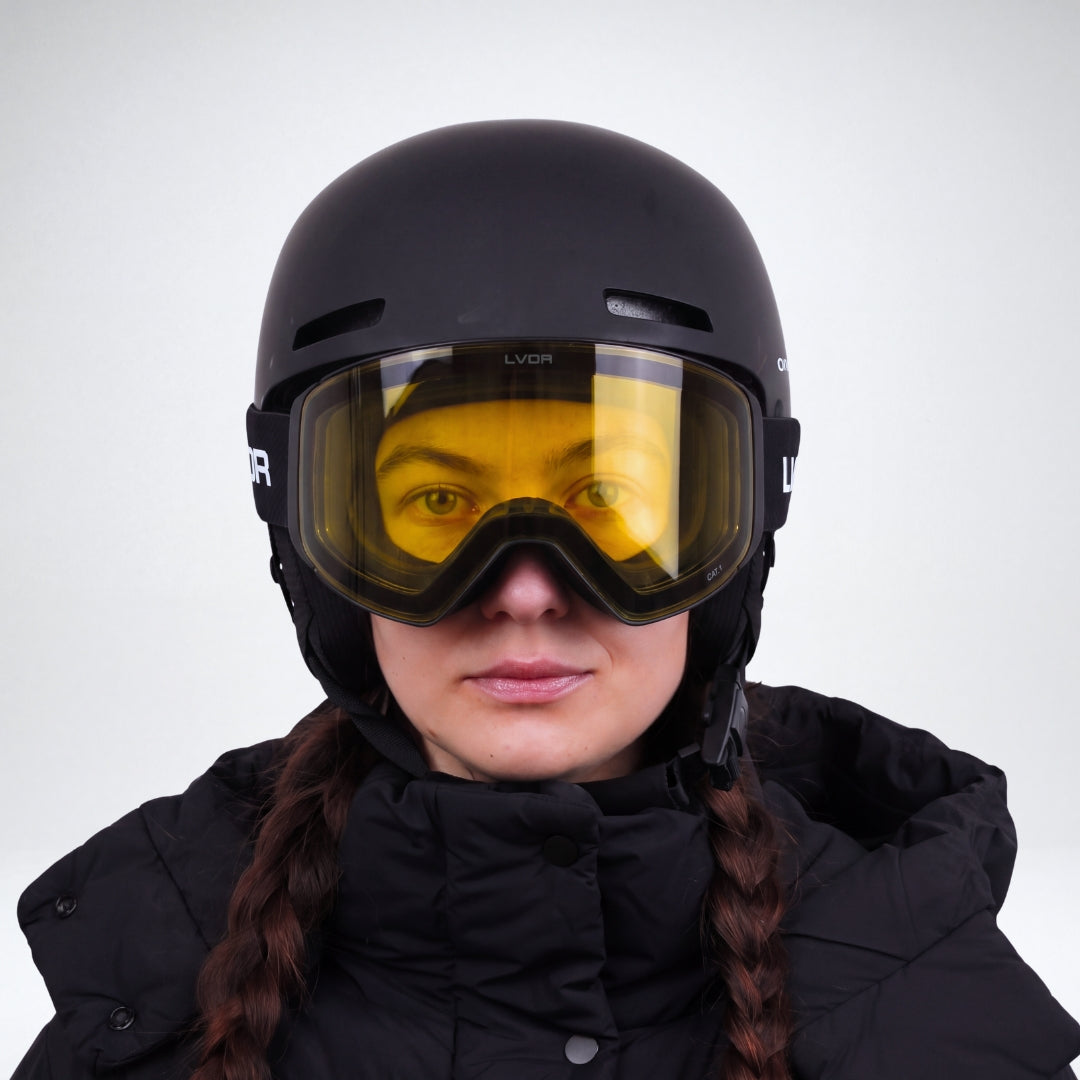
With contact lenses, you can wear the ARC like any other ski goggles. Then you get the MagSnap magnetic lens system, the double lens with anti-fog coating and the yellow fog & snow lens (CAT.1) that comes with every ARC. How the lens system works is explained in Ski goggles with interchangeable lenses.
If you want to wear your glasses under your goggles, choose a model the manufacturer explicitly labels as OTG and try it on with your own glasses and helmet.
Frequently asked questions
Can you ski with glasses?
Yes. Glasses wearers ski with OTG goggles over their own glasses, with contact lenses or with a prescription insert in the goggles. If you wear glasses underneath, it's important that they sit securely, aren't pressed against your face and have plastic lenses.
What are the best ski goggles for glasses wearers?
The ones that fit your glasses and your helmet, because there's no single best pair. Look for the OTG label, enough depth, room for the arms and good ventilation. A test winner won't help you much if your frame doesn't fit inside.
Do OTG ski goggles fit every helmet?
Not automatically. OTG models often have a larger frame that still has to fit under the helmet edge without a gap and mustn't press on the glasses underneath. You avoid pressure points by trying on helmet, goggles and glasses together.
Is it dangerous to wear glasses under ski goggles?
In a fall, everyday glasses can break or be pushed into your face, which is why the KGS calls them an injury risk during sport. If you stick with glasses, choose a pair with plastic lenses and a flexible frame. Contact lenses or a prescription insert are the safer option.
Ski goggles pressing on your nose: what can you do?
With glasses underneath, this is often down to a frame that's too large or sits too low, or a strap that's too tight. First loosen the strap and check whether your glasses have enough room under the goggle frame. Other causes are covered in our guide to ski goggles and helmets.
For many glasses wearers, well-fitting OTG ski goggles are the simplest solution; contact lenses and prescription inserts are the alternatives without a second lens surface. If you ski with contact lenses and want goggles with a magnetic interchangeable lens, take a look at the ARC ski goggles. Everything else about buying is summed up in our ski goggles buying guide.