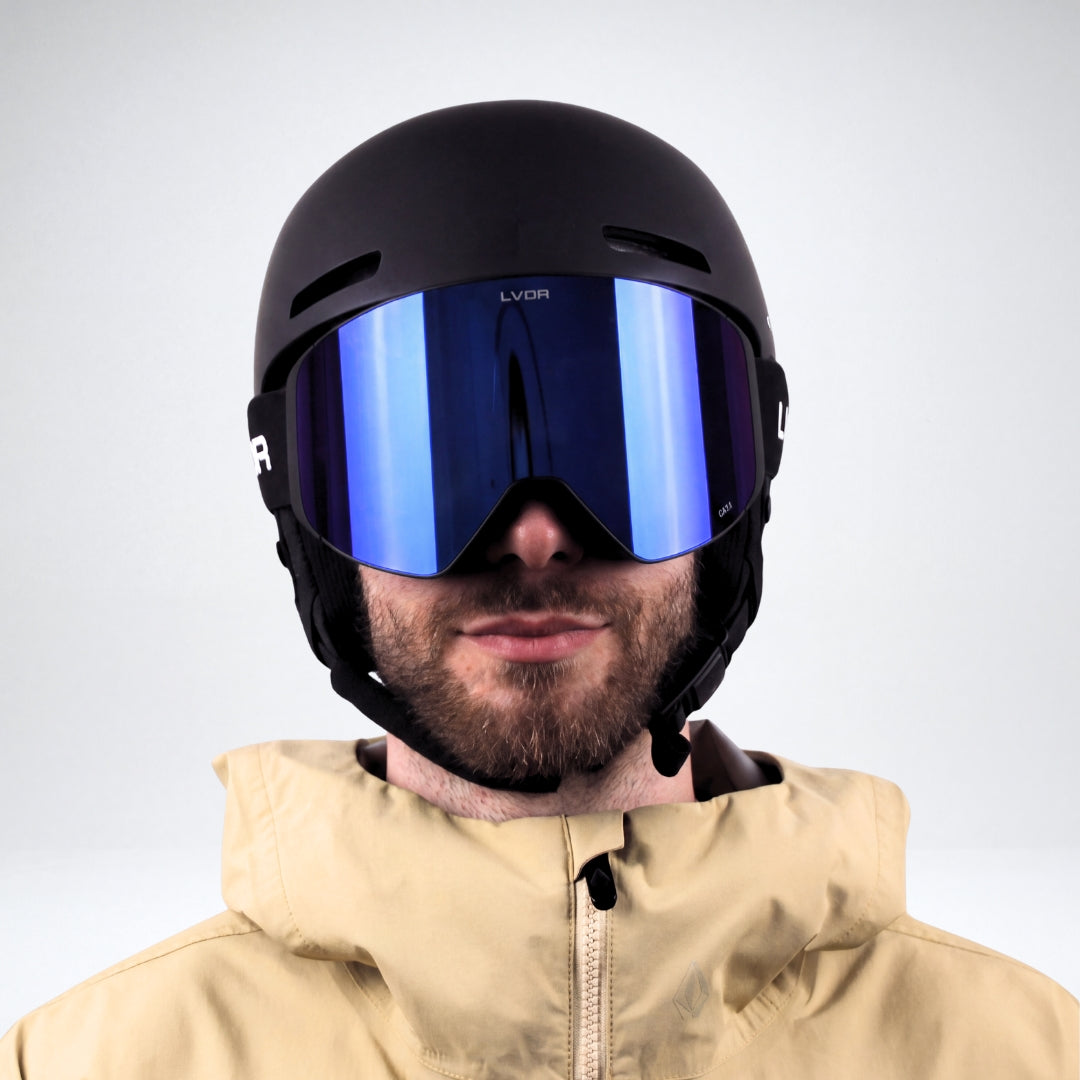
Article: Buying ski goggles: what really matters

Buying ski goggles: what really matters
If you want to buy ski goggles, look for five things: they sit without pressure, meet your helmet without a gap, offer 100% UV protection, barely fog up thanks to an anti-fog coating and ventilation, and have a lens that suits the light – ideally with a second lens for fog. If you wear glasses, the goggles also need enough room for them. Brand, design and lens shape are secondary.
This buying guide goes through every point in turn. You'll get a checklist for trying goggles on, honest answers on tests and prices, and a link to a detailed guide for each topic.
Buying ski goggles: the checklist
- Fit: The foam sits flush all the way round, and nothing presses on your nose or cheekbones.
- Helmet: There's no gap between helmet and goggles, and the strap lies straight on the helmet.
- Lens shape: Whether it's spherical, toric or cylindrical matters less than the quality of the lens.
- Filter category: S2 or S3 as the main lens, S1 for fog and flat light.
- Interchangeable or photochromic: worthwhile if you ski in all weathers.
- Fogging: an anti-fog coating on the inside and ventilation in the frame.
- UV protection: UV400 and the CE mark, regardless of tint.
- Glasses wearers: an OTG model, a clip with prescription lenses or contact lenses.
- Price: factor in the cost of a second lens from the start.
Which ski goggles suit my face?
The right ski goggles have foam that sits evenly all the way round, don't press on your nose or cheekbones and leave your nostrils free. If the frame sticks out at the sides or there are gaps at the temples, cold air gets in and your eyes water. They're too small if the frame noticeably restricts your field of view at the sides.
Many ski goggles come in several frame sizes or in versions for narrow faces. But the size on the label is no substitute for trying them on, because everyone's nose shape and cheekbones are different.
How to check the fit when trying ski goggles on
- Put the goggles on without a helmet and only tighten the strap slightly. The foam should make contact everywhere.
- Breathe through your nose a few times. If your nostrils get pinched, the goggles are too big or sit too low.
- Put your helmet on. The goggle frame and helmet edge should meet without a gap, without the helmet pushing the goggles down.
- Look left, right, up and down. The frame should cut off as little of your field of view as possible.
- Wear the combination for a few minutes. You often only notice pressure points after a while.
Women's or men's ski goggles: is there a difference?
Not technically; the label mainly tells you something about size and design. There are no separate women's or men's lenses, and many ski goggles are unisex anyway. If you have a narrow face, make sure, whatever the label says, that the frame doesn't stick out and the foam still sits flush all the way round.
Which ski goggles fit which helmet?
Ski goggles fit your helmet if the goggle frame and helmet edge meet without a gap, the strap lies straight on the helmet and the helmet doesn't push the goggles onto your nose. The only way to be sure is to try them on together. The German consumer organisation Stiftung Warentest advises either buying helmet and goggles together or taking your old goggles along when you try on helmets, as that's the only way to avoid pressure points or a gap (Stiftung Warentest: ski and snowboard helmets).
- Gap at the forehead: The gap between helmet and goggles is called the ‘goggle gap’. Your forehead freezes there, and cold air reaches your eyes.
- Slipping strap: A silicone strip on the inside of the strap holds the goggles on the smooth helmet shell.
- Covered vents: The helmet shouldn't cover the vents at the top of the goggle frame, otherwise the lens fogs up faster.
Helmet and goggles don't have to be the same brand. How to solve typical problems such as pressure on your nose is explained in our guide How to match ski goggles and helmet.
Spherical or cylindrical: which lens shape is better?
Cylindrical lenses are only curved horizontally, spherical lenses are also curved vertically, and toric lenses are somewhere in between. Spherical lenses are considered to distort less at the edges and leave more space in front of the eyes. Cylindrical lenses are flatter and simpler in design.
For most recreational skiers, fit and lens quality matter more than shape. When the difference becomes noticeable is explained in our guide Spherical vs cylindrical ski goggles.
Which filter category and lens colour do you need?
For sunshine you need a category S3 lens, for changing cloud S2, and for fog, snowfall and flat light a light S1 lens. The categories from S0 (almost clear) to S4 (very dark) are set by the standard for ski and snowboard goggles, EN ISO 18527-1.
| Weather | Category and lens colour |
|---|---|
| Sun, clear sky | S3, grey or brown, often mirrored |
| Sun and cloud | S2, orange, red or brown |
| Fog, snowfall, flat light | S1, yellow or orange |
| Floodlights | S0, clear |
| Sun on the glacier | S4, very dark |
The German Board for Good Vision, Kuratorium Gutes Sehen, recommends the same matches (KGS guide to winter sports eyewear). For normal pistes, S4 is too dark. All categories, colours and special cases are explained in our guide Which ski goggle lens for which weather.
Interchangeable, photochromic or one lens for everything?
If you ski in all weathers, choose ski goggles with interchangeable lenses or a photochromic lens. If you almost only ski in sunshine, one lens is enough. With a single lens you always make a compromise, because a dark lens is too dark in fog and a light one too light in the sun.
- You mostly ski on sunny days: An S3 lens is enough; if you get lots of cloudy days, S2 is the better choice.
- You ski in all weathers and want to choose deliberately: Ski goggles with interchangeable lenses, ideally with a magnetic system so the swap is quick.
- You never want to swap: A photochromic lens adjusts its tint by itself. Make sure it reaches at least S3 in its darkest state.
- You only want to buy one lens: S2 is the best compromise.
How magnetic, clip and frame systems work and which lenses you should combine is explained in our guide Ski goggles with interchangeable lenses.
What helps against foggy ski goggles?
An anti-fog coating on the inside, a double lens and ventilation in the frame help against fogging. The Kuratorium Gutes Sehen names these three points too. The ARC has all three. The KGS also points out that goggles that sit too tightly fog up faster, because the air no longer circulates.
How you use them matters just as much. Never wipe the inside with a glove or tissue, because that destroys the coating. Don't push the goggles up onto your sweaty forehead during breaks, and keep the vents clear. What you can do if they fog up anyway is covered in our guide How to clean ski goggles and stop them fogging up.

How important is UV protection in ski goggles?
Very important, because your eyes get considerably more UV radiation in the mountains than in the valley. According to Germany's Federal Office for Radiation Protection (BfS), UV radiation increases by about 10% per 1,000 metres of altitude, and fresh snow reflects up to 90% of it. Too much UV can inflame the cornea, a condition known as snow blindness.
So look for the UV400 label and the CE mark. The tint says nothing about UV protection; even a light yellow lens can offer full protection.
Ski goggles for glasses wearers: OTG, clip or contact lenses?
As a glasses wearer, you have three options: OTG ski goggles that fit over your glasses, a clip with prescription lenses inside the goggles, or contact lenses. OTG ski goggles (over the glasses) have enough room inside for your glasses without pressing on your nose or temples. Be sure to try the combination on with your own glasses.
- OTG ski goggles: You use your usual glasses. According to the Kuratorium Gutes Sehen, however, normal everyday glasses are an injury risk during sport, even under ski goggles.
- Clip with prescription lenses: According to the KGS also suitable for higher dioptres, but it restricts the field of view and fogs up faster because the lenses sit close to the eyes.
- Contact lenses: They don't fog up and fit under any ski goggles, but take some getting used to.
Another option is a ski helmet with a visor, which has room for your glasses underneath. Everything about size, frame shape and fogging is explained in our guide Ski goggles for glasses wearers.
Ski goggle tests: what independent tests show
Independent tests show three things: most goggles meet UV protection requirements, the differences lie in scratch resistance, fit and handling, and a high price doesn't guarantee a good result. The well-known consumer tests of ski goggles are, however, several years old now.
- Stiftung Warentest, issue 1/2013: 13 ski goggles with interchangeable lenses. All but one offered the promised UV protection, all passed the impact test, but not all lenses were scratch-resistant. Changing lenses was easiest with a magnetic system.
- Kassensturz (Swiss consumer TV programme, SRF), January 2017: 15 ski goggles. All protected very well against UV, the cheapest model came off worst, and a model costing CHF 99.90 was rated ‘very good’.
- Konsument (Austrian consumer magazine), February 2019: 13 self-tinting ski goggles. Only two were rated ‘good’, three didn't reach the required UV protection, and the lenses weren't dark enough for high-altitude sun.
The ARC ski goggles are newer than these tests and weren't tested in them. What to take from the tests is mainly what you can check yourself: UV400 and the CE mark, plus goggles that suit your face and your helmet.
How much do good ski goggles cost?
Good ski goggles don't have to be the most expensive; in tests, pricey models weren't automatically ahead. The cheapest ones did tend to perform poorly, though. More money mainly buys comfort and flexibility, such as a second lens, a faster lens change system or a photochromic lens. When comparing, factor in whether a second lens is included or costs extra.
For reference, the goggles in the tests above cost between CHF 49 and CHF 250 (Kassensturz) and between €69.90 and €199.99 (Konsument, self-tinting models only). With the ARC, the yellow second lens for fog and snowfall is already included.
- Worth paying for: a size that really fits, a second lens or a photochromic lens, an OTG model if you wear glasses.
- You can do without: a big logo, a special mirror colour, an S4 lens for normal pistes and polarisation, which isn't a must for ski goggles.
Common mistakes when buying ski goggles
- Buying on looks alone: Goggles that look good but press or leave gaps are ones you won't want to put on again after the first day.
- Trying them on without a helmet: Only with a helmet do you see whether there's a gap or the goggles get pushed onto your nose.
- Only a dark lens: In fog and flat light you can barely see contours through an S3 lens.
- Buying too big: A frame that sticks out slips, presses on your nose and lets the cold in.
- Glasses wearers trying them on without their own glasses: Only trying them on with exactly those glasses shows whether they fit underneath.
When do you need new ski goggles?
You need new ski goggles, or at least a new lens, when the lens is scratched or constantly fogs up, or the foam is crumbling. Scratches scatter light and create visual noise in sunshine and flat light. If goggles keep fogging up even though the inside is dry, the anti-fog coating is often worn out.
A stretched strap or a cracked frame are also reasons to replace them. After a hard fall, check the lens and frame carefully, because fine cracks can weaken their resistance to breaking.
The ARC ski goggles: who they suit and who they don't
Our ARC ski goggles are designed around the points on this checklist. Here are the facts:
- Lens change system: MagSnap with 10 neodymium magnets (N52), lens changes in seconds, even with gloves.
- Lenses: Chrome Mirror or Blue Ice (CAT.3) for lots of sun, Red Fire or Aurora (CAT.2) for changing light, all mirrored. The yellow fog & snow lens (Nebel & Schnee) for flat light comes free with every ARC.
- Optional: the photochromic Cherry Pink ARC lens (CAT.0–3), which only fits the new ARC.
- Lens shape: cylindrical, meaning curved horizontally and flat vertically.
- Vision and protection: UV400, double lens, anti-fog coating, ventilation, wide field of view.
- Fit: three-layer comfort foam, silicone strip on the strap, compatible with common helmets, unisex, not OTG: they can't be worn over prescription glasses.
- Size: 176 mm wide, 105 mm high, 38 mm nose cut-out (according to the technical drawing in our shop).
- In the box: goggles with your chosen lens, yellow lens (CAT.1), premium hard case styled like a snow boot, microfibre pouch for the goggles and lens.
The ARC suits you if you ski in all weathers and want to switch between a dark and a light lens without fiddling. It doesn't suit you if you want to wear your glasses underneath, or if you're looking for polarised lenses, a spherical lens or a category 4 lens for glaciers. You'll find the ARC and the extra lens in our ski goggles collection.

Frequently asked questions
How can I tell if ski goggles are good?
Good ski goggles sit without pressure, seal well against the helmet, and have UV400 and the CE mark, an anti-fog coating and ventilation. Add to that a lens that suits your typical weather, ideally with a second lens for poor visibility.
What are the best ski goggles?
There's no single best pair of ski goggles. The best ones are those that suit your face, your helmet and your conditions. A model that fits others well may press on you, which is why trying them on matters more than any ranking.
What size ski goggles do I need?
The goggles should be roughly as wide as your face and meet your helmet. If the frame sticks out at the sides, they're too big; if it severely restricts your view, they're probably too small. If you have a narrow face, it's worth looking at smaller frame sizes.
Can I ski in sunglasses?
In sunshine and at a relaxed pace, that's fine if the glasses have UV400 and seal well at the sides. But ski goggles protect much better against wind, snowfall and cold. The differences are explained in the article Ski goggles or sports glasses.
Which filter category do I need for a ski holiday?
For a typical ski holiday in the Alps, S3 for sunny days is the standard choice, plus a light S1 lens for fog and snowfall. If you only want to take one lens, S2 is the best compromise.
The bottom line: try goggles and helmet on together and plan for a second lens for bad weather. If you're looking for ski goggles with interchangeable lenses for sun and fog that work with common helmets, take a look at our ARC ski goggles.