UV400 Protection in Sports Glasses: Why it's So Important
UV protection sounds like a given – but it's not. Many inexpensive sports glasses advertise "UV protection," but only offer UV380. The difference can determine the long-term health of your eyes.
UV400 explained: What the number means
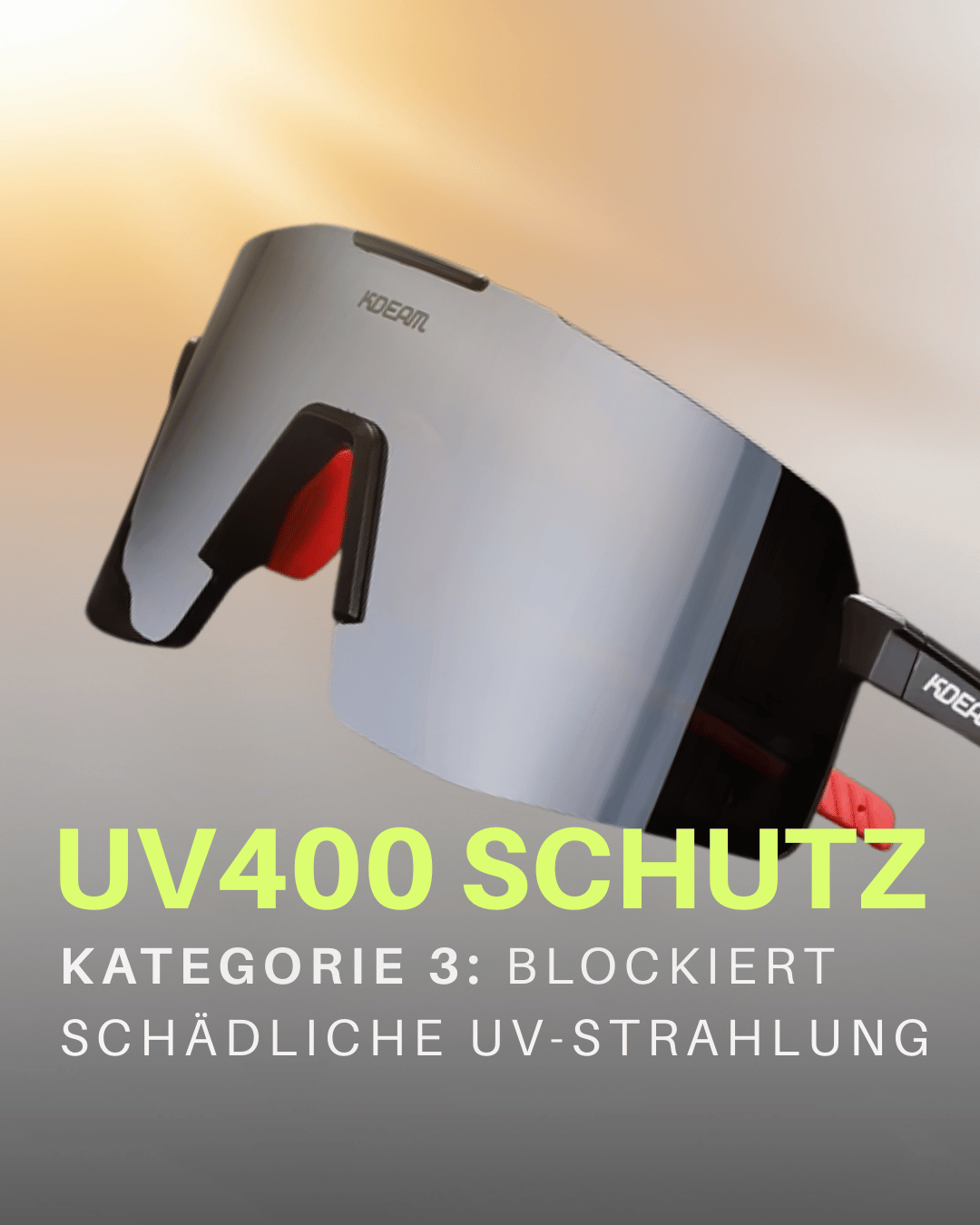
UV400 = all rays up to 400 nm blocked. This fully covers UVA (315-400 nm) and UVB (280-315 nm). UV380 allows a portion of the long-wave UVA radiation to pass through – precisely the kind that penetrates deepest into the eye.
Why UV protection is especially important for sports
Longer exposure: When running or cycling, you're in the sun for 30-120 minutes. The cumulative UV exposure over years is the problem.
Reflections: Water reflects 25% of UV radiation, sand 15%, snow 80%. On wet roads, you're exposed from all sides.
Cloudy ≠ safe: Up to 80% of UV radiation penetrates clouds.
What happens without UV protection?
Short-term: Photokeratitis – "sunburn" on the cornea. Burning eyes, light sensitivity, blurred vision.
Long-term: Increased risk of cataracts and macular degeneration. Regular UV protection significantly reduces the risk of cataracts.
Recognizing genuine UV400 protection
Look for the explicit statement "UV400" or "100% UV protection up to 400 nm". A CE mark alone is not enough. If in doubt, any optician can measure the UV protection.
Important: The tinting strength has nothing to do with UV protection. Even clear lenses can offer full UV400, while darkly tinted cheap lenses without a UV filter are dangerous – dark lenses dilate the pupils.
UV400 + polarization = best protection
UV400 blocks harmful invisible radiation, polarization reduces visible glare. Together, you get maximum protection and comfort.
All Livadora v7 sports glasses combine UV400 with polarized lenses – standard, not an extra.