Spherical vs cylindrical ski goggles: meaning and difference
Spherical means curved like a ball; cylindrical means curved in one direction only, like the side of a can. On ski goggles, a spherical lens curves both horizontally and vertically, while a cylindrical lens curves only horizontally and stays flat from top to bottom. At the optician's, the same words mean something else: sphere stands for short- or long-sightedness, cylinder for astigmatism.
Here you'll find out exactly what the terms mean, the pros and cons of each lens shape on ski goggles, how to tell them apart and what aspheric, toric and anamorphic have to do with it.
What does spherical mean?
Spherical means ball-shaped, or “relating to a sphere”. The word comes from the Greek sphaira, meaning ball. A spherical surface is a section of the surface of a sphere and is therefore curved equally in every direction.
Outside optics, you mainly come across the word in mathematics, where spherical trigonometry calculates triangles on the surface of a sphere, and in astronomy, where it relates to the celestial sphere. In German, the word “sphärisch” is also used figuratively for music that sounds floating and spacious; in English you would call that “ethereal” or “atmospheric” rather than spherical. You may also see “spheric”, a less common variant of the same word.
What does cylindrical mean?
Cylindrical means shaped like a cylinder: like a roller, a can or a tube. A cylindrical surface curves in one direction and is straight at right angles to it. Roll a sheet of paper into a tube and you get exactly that kind of surface.
Cylindrical is often confused with conical. A cone tapers towards one end, while a cylinder stays the same thickness all the way along. That's why components are called cylindrical when their diameter is constant throughout and conical when it changes.
Spherical vs cylindrical ski goggles: what's the difference?
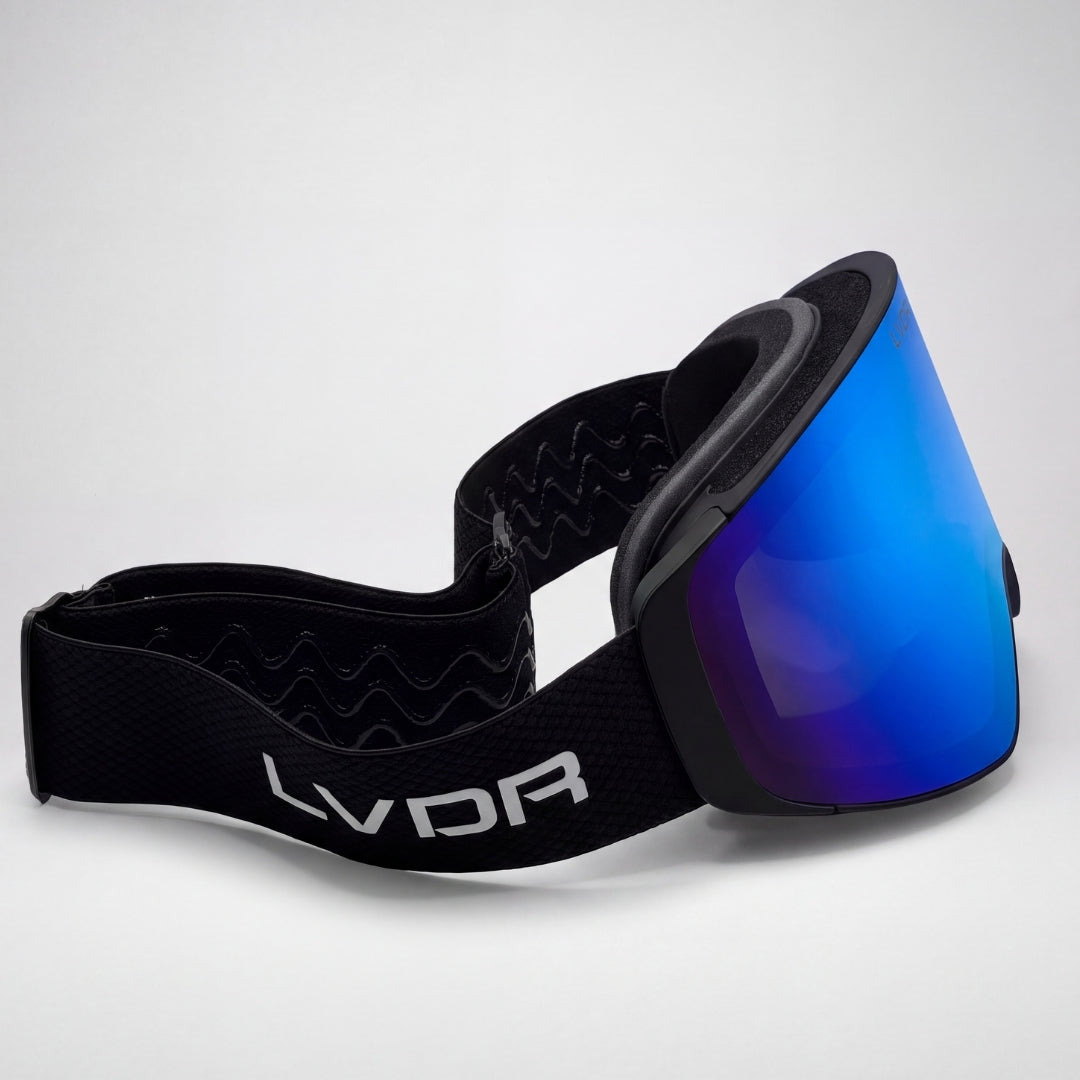
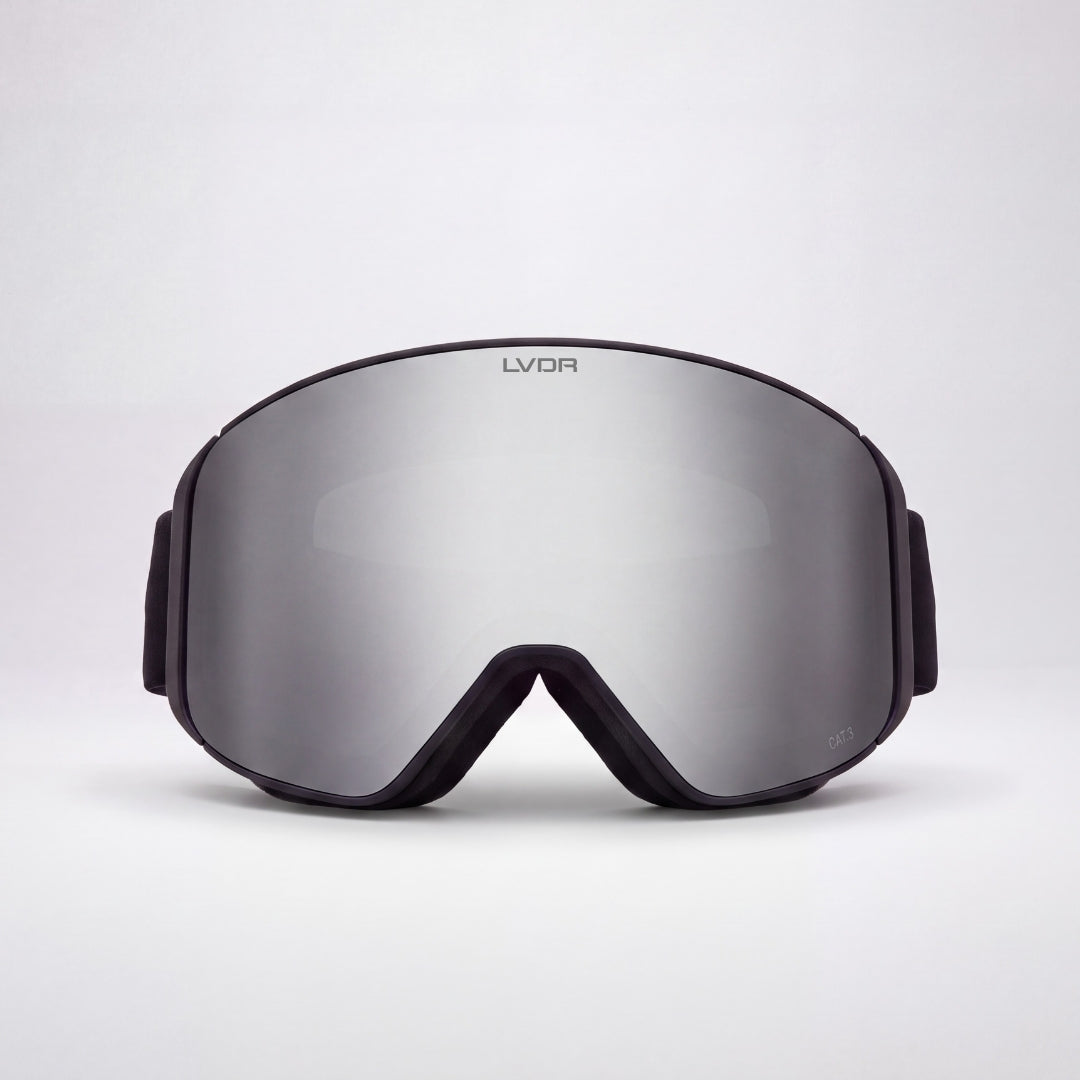
A cylindrical ski goggle lens curves only from left to right; a spherical lens also curves from top to bottom. Picture a drinks can and a ball. A piece cut from the can corresponds to the cylindrical lens, a piece cut from the ball to the spherical one. So with cylindrical or spherical ski goggle lenses, it’s about the curve, not the colour or tint.
The German Board for Good Vision (Kuratorium Gutes Sehen) sums up the consequences like this: cylindrical lenses offer a wide horizontal viewing angle that is somewhat limited vertically. Spherical lenses curve outwards, improve all-round vision and increase the volume of air inside the goggles, which helps ventilation (sehen.de: ski goggles).
| Feature | Cylindrical | Spherical |
|---|---|---|
| Curvature | horizontal only | vertical too |
| Side profile | straight | curved |
| Field of view | wide to the sides | wide all round |
| Edges | more distortion | less distortion |
| Air volume | smaller | larger |
| Price | often cheaper | usually pricier |
| Build | flat | bulbous |
The table shows typical tendencies, not measurements. How good the view through a lens actually is depends as much on material, manufacturing and frame as on its shape.
What are toric ski goggles?
A toric lens sits between the two shapes: it curves strongly horizontally and less vertically. The name comes from the torus, the shape of a ring or a bicycle inner tube, whose surface curves to different degrees in two directions. Toric ski goggles aim to combine the flatter build of a cylindrical lens with less distortion at the edges. How pronounced the vertical curve is varies from model to model.
Pros and cons of spherical ski goggles
Spherical lenses give you more all-round vision and more air in front of your eyes, but they are more complex to make and usually more expensive. Their curve roughly follows the spherical shape of the eye.
- Less distortion at the edges: When you look to the side or down at your ski tips, the image stays more even.
- More interior volume: There's more air between lens and face. This can support ventilation but won't prevent fogging on its own.
- Higher price: The double curve is more complex to manufacture.
- Build: The lens sticks out at the front. Some people like this “bubble look”, others find it bulky.
Pros and cons of cylindrical ski goggles
Cylindrical lenses have a wide field of view to the sides, are simpler to make and look flat and understated. They are the classic design.
- Wide horizontal field of view: The horizontal curve draws the lens far round towards the temples.
- Often cheaper: A lens curved in one direction only is easier to manufacture.
- Compact look: The goggles are less bulky at the front.
- Limitations: The field of view is slightly narrower upwards and downwards, and the image can distort slightly at the top and bottom edges.
Whether you notice this edge distortion at all depends on the lens quality and on how you look around. When you're skiing or riding, you spend most of the time looking straight ahead through the centre of the lens.
Which is better: spherical or cylindrical?
Neither shape is better across the board. Spherical has advantages at the edges and in air volume; cylindrical is simpler, flatter and often cheaper. For your vision on the slopes, filter category, fit and protection against fogging matter at least as much.
How to decide:
- If maximum all-round vision matters to you and you ride a lot off-piste or at speed, try spherical or toric lenses.
- If you're watching the price or like a flat look, a cylindrical lens is a solid choice.
- If you often ski in fog or flat light, a light contrast lens will do more for you than any lens shape. Which colour suits which conditions is covered in Which ski goggle lens colour for which weather?
- If you wear prescription glasses, space for your glasses comes first. What to look out for is explained in Ski goggles for glasses wearers.
- If the goggles press or leave a gap to your helmet, even the best lens won't help. Check the fit with our guide Ski goggles and helmet.
If your goggles fog up, it's usually down to ventilation, fit and handling rather than the lens shape. You'll find tips in How to clean ski goggles and stop them fogging up. How all the criteria fit together is summed up in our ski goggle buying guide.
How can you tell if ski goggles are spherical?
Hold the goggles sideways at eye level: if the lens runs straight from top to bottom, it's cylindrical; if it also bulges forward vertically, it's spherical. If you're not sure, these three steps will help.
- Side profile: From the side, a cylindrical lens looks like a vertical wall. A spherical lens bulges clearly forward in the middle, a toric one a little less.
- Edge test: Place the long edge of a plastic card vertically against the outside of the lens without pressing. If it touches along the full height, the lens is cylindrical. If it only touches in the middle and rocks, it's spherical or toric.
- Product description: Most manufacturers state the lens shape. “Frameless” or “rimless”, on the other hand, only describes the frame and says nothing about the curve.
Sphere and cylinder at the optician's: what the values mean
On a glasses prescription, the sphere (SPH) gives the strength of short- or long-sightedness in dioptres, and the cylinder (CYL, or ZYL on German prescriptions) the strength of astigmatism. These values have nothing to do with the curve of a ski goggle lens.
- Sphere (SPH): A minus sign means short-sightedness, a plus sign long-sightedness. The values go up in steps of 0.25.
- Cylinder (CYL, ZYL): If there's a number here, you have astigmatism. The lens then gets an additional curve, the cylinder, which refracts light more strongly in one direction than in the other.
- Axis (A, AX): This gives the orientation of the astigmatism as an angle between 0 and 180 degrees.
That's how the Kuratorium Gutes Sehen explains it in its overview of the glasses prescription. An example: SPH −2.00, CYL −0.75, A 90 means 2 dioptres of short-sightedness plus 0.75 dioptres of astigmatism, whose orientation is given by the axis of 90 degrees. Opticians call lenses that correct both sphero-cylindrical, and the measurement itself is called a refraction.
For ski goggles, you only need these values if you want prescription lenses fitted. The options for sport are covered in our guide Prescription sports glasses.
Spherical, aspheric, toric: spectacle lenses compared
Spherical and aspheric spectacle lenses correct short- and long-sightedness; toric lenses correct astigmatism (sehen.de: spectacle lenses).
- Spherical: ground to a spherical shape, very sharp straight ahead, slightly less sharp at the edges.
- Aspheric: the curve flattens towards the edge. The lens stays sharp right to the edge and is thinner and lighter.
- Toric: two curves of different strength that compensate for astigmatism.
So aspheric vs spherical is a question of edge sharpness, lens thickness and price. A spherical surface refracts light more strongly at the edge than in the centre, which specialists call spherical aberration. An aspheric surface compensates for this but is more complex to grind and costs a little more. Contact lenses are split the same way: spherical lenses for short- and long-sightedness, toric lenses for astigmatism.
What is a cylindrical lens?
A cylindrical lens refracts light in one direction only and therefore focuses it into a line rather than a point. That's exactly what astigmatism needs, because the eye refracts light more strongly in one direction than in the other. Outside eye care, cylindrical lenses are used in line lasers, for example, which project a straight line onto a wall.
A cylindrical ski goggle lens, by contrast, is not a corrective lens. Non-prescription lenses are designed to change the image as little as possible; only their outer shape is cylindrical.
Anamorphic vs spherical: what does it mean?
In this context, anamorphic and spherical are film and photography terms and have nothing to do with ski goggles. A spherical lens uses round, evenly curved lens elements and reproduces the subject without squeezing it. An anamorphic lens also contains cylindrical elements that squeeze the image horizontally so that a widescreen picture fits on the sensor. On playback it is stretched back out; typical signs are oval out-of-focus highlights and horizontal streaks of light.
What lens shape do the ARC ski goggles have?
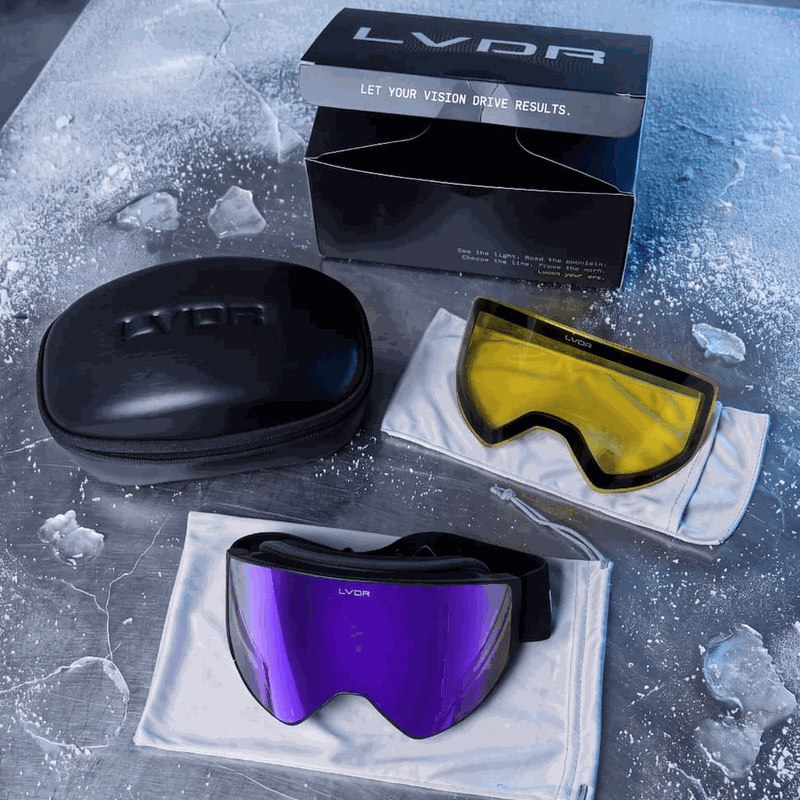
All lenses for the ARC ski goggles are cylindrical: curved horizontally, flat vertically. That applies to the mirrored main lenses Chrome Mirror and Blue Ice (CAT.3) and Red Fire and Aurora (CAT.2), to the yellow fog & snow lens (Nebel & Schnee) that comes with every ARC, and to the optional photochromic Cherry Pink lens (CAT.0–3). The photochromic lens only fits the current ARC, not the previous generation.
This gives you the wide horizontal field of view and flat build of a cylindrical lens. If you specifically want a spherical lens that bulges forward, the ARC isn't the right choice for you. Whatever their shape, all lenses have UV400, plus an anti-fog coating, ventilation and a wide field of view. You swap lenses in seconds using the MagSnap magnetic system with 10 neodymium magnets, even with gloves on – how it works is explained in our article on the magnetic ARC ski goggles.

Frequently asked questions
What's the difference between sphere and cylinder?
A sphere is a ball and is curved equally in all directions; a cylinder is curved in one direction only. In eye care, the sphere therefore corrects short- and long-sightedness, which is equally strong in all directions, and the cylinder corrects astigmatism, which is stronger in one direction than in the other.
Do spherical ski goggles fog up less?
The larger air volume can help, but it's no guarantee. Whether goggles fog up depends mainly on the anti-fog coating, unobstructed vents, the fit with your helmet and how you handle the goggles.
Does the lens shape of ski goggles have anything to do with your prescription?
No. On ski goggles, spherical and cylindrical only describe the curve of the lens. The values of the same name on your prescription describe your eyesight and only matter if you need corrective lenses.
What's the difference between spherical and toric?
Spherical means curved equally in all directions, toric means curved to different degrees in two directions. In spectacle lenses and contact lenses, toric versions correct astigmatism; on ski goggles, toric refers to an in-between shape between cylindrical and spherical.
Is your vision worse with cylindrical ski goggles?
Not straight ahead. Differences, if any, show up at the top and bottom edges, where a cylindrical lens can distort slightly more. Whether that bothers you is individual – a well-made lens matters more than the shape.
If you're looking for ski goggles with cylindrical lenses that you can swap in seconds to suit the light, take a look at the ARC ski goggles or browse all our ski goggles.