
Article: Sports Glasses for Prescription Wearers: All Options at a Glance
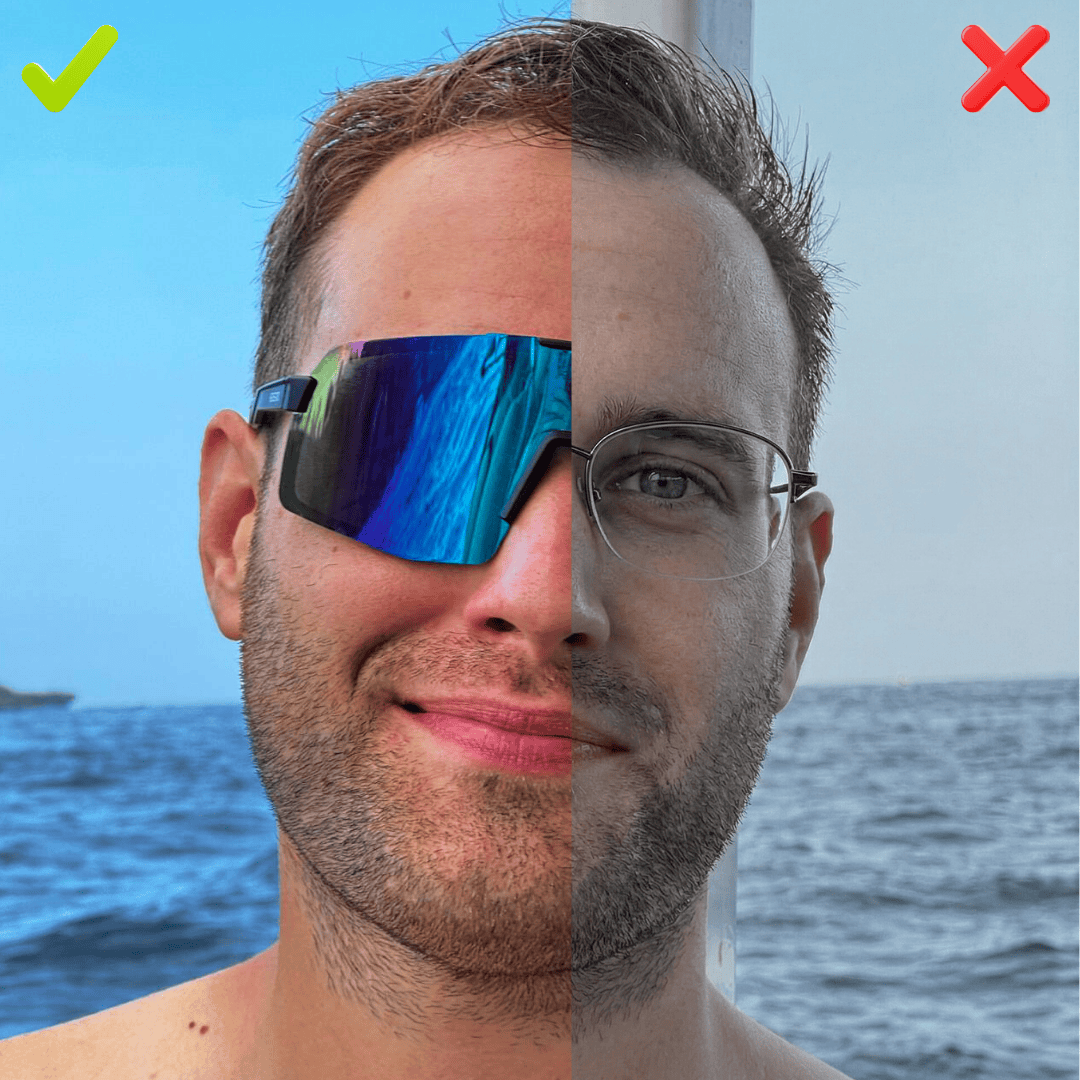
Sports Glasses for Prescription Wearers: All Options at a Glance
Sports Glasses for People Who Wear Glasses: All Options at a Glance
The simplest solution: adhere stick-on lenses with prescription to any sports glasses. For skiers: OTG (Over-The-Glasses) ski goggles that fit over your regular glasses. Contact lenses are the third option, but not suitable for everyone.
Do you wear glasses but still want eye protection during sports? You're not alone — over 40% of Germans are nearsighted or farsighted. We'll show you all the ways you can benefit from sports glasses as a glasses wearer.
Option 1: Stick-on Lenses
Our stick-on lenses are the most flexible solution for glasses wearers with presbyopia (farsightedness). These semi-circular lenses are attached to the inside of your sports glasses or sunglasses with a drop of water.
Advantages: Works with any sports glasses and sunglasses, various diopters available, reusable, removable without residue, invisible from the outside, no additional glasses needed. Limitation: Covers the lower field of vision (reading area) — distant vision remains uncorrected. Ideal for farsighted individuals who need near vision (phone, navigation, menus).
Perfect for: Runners, cyclists, hikers, skiers, beachgoers — anyone who wants to keep their favorite glasses and supplement them with a prescription.
Option 2: OTG Ski Goggles (Over-The-Glasses)
For skiers and snowboarders who wear corrective glasses, OTG ski goggles are the best solution. These goggles are shaped on the inside to fit over your regular glasses — without pressing or fogging up.
Our "The Arc" ski goggles are OTG-compatible. The internal shape provides enough space for most corrective glasses, and the anti-fog dual-layer technology prevents both the ski goggles and corrective glasses from fogging up.
Advantages: Full visual acuity with your familiar glasses, no adjustment period, works with progressive and single-vision glasses. Limitation: Not all corrective glasses fit — very large or wide frames can be problematic. Ideally, use compact corrective glasses.
Option 3: Contact Lenses + Sports Glasses
The third option: wear contact lenses and regular sports glasses over them. This gives you full visual acuity at all distances and the complete selection of sports glasses.
Advantages: Maximum flexibility, full correction, no restrictions on glasses choice. Limitation: Not everyone tolerates contact lenses. They can dry out in wind and dry air (especially when cycling). Daily disposable lenses are the more hygienic choice for sports.
Tip: If you tolerate contact lenses, combine them with a Livadora v7 Pro — it also protects your eyes from wind and drying out, while the contact lenses provide visual acuity.
Which option is right for you?
| Situation | Best Option |
|---|---|
| Farsighted, need near vision during sports | Stick-on lenses |
| Nearsighted, want to wear sports glasses | Contact lenses + sports glasses |
| Glasses wearer, wants to ski | Arc OTG ski goggles |
| Progressive lenses, wants to cycle | Contact lenses + v7 Edge |
| Reading glasses needed, wants to read at the beach | Stick-on lenses in sunglasses |
Frequently Asked Questions
Do stick-on lenses fit all sports glasses?
Yes, the semi-circular lenses adhere to any smooth lens surface — sports glasses, sunglasses, ski goggles. They are applied with a drop of water and can be removed without residue.
Can I wear my progressive lenses under the Arc ski goggles?
Yes, as long as your progressive lenses are not wider than approx. 14 cm. The Arc has enough internal space for most corrective glasses. Sporty, narrow frames work best.
Are there sports glasses with built-in prescription?
Some opticians offer to fit sports glasses with ground lenses in your prescription. However, this is significantly more expensive (€200-400) and limits the model selection. Our stick-on lenses offer a flexible and affordable alternative for farsighted individuals.
Do contact lenses dry out when cycling?
Yes, especially with headwinds and dry air. Sports glasses like the v7 Edge with an extra-wide visor significantly reduce airflow to the eyes and protect contact lenses from drying out. The combination of contact lenses and wind-protective sports glasses is the ideal solution for many cyclists.
%20ski%20go...)